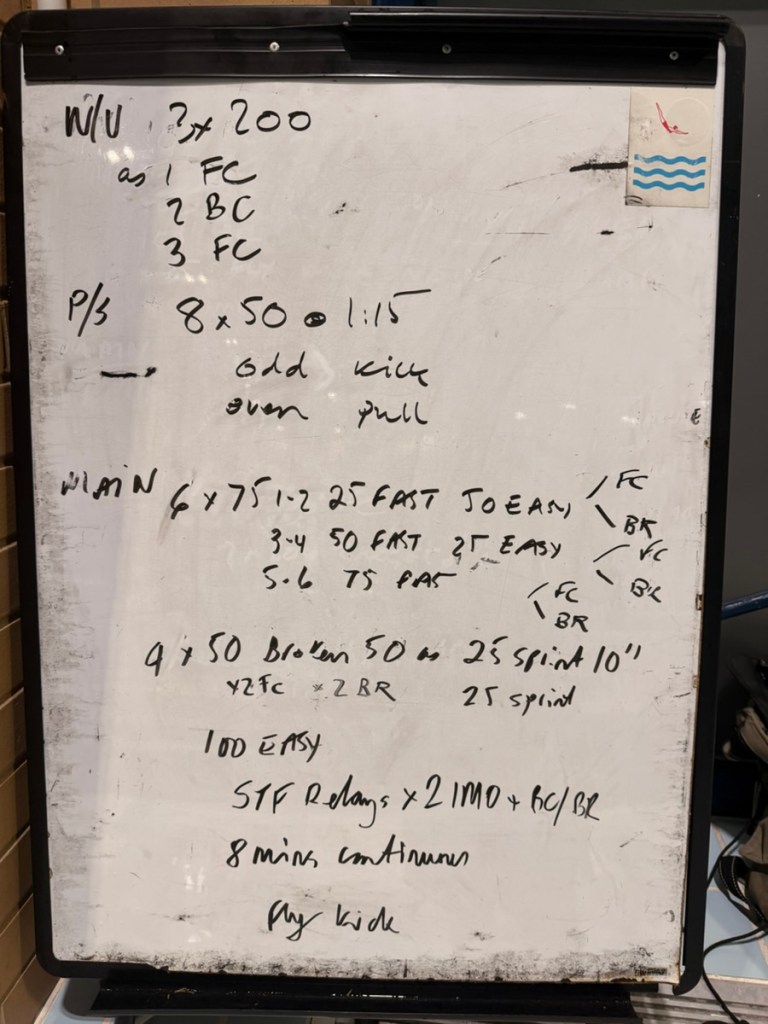
There’s more to this than meets the eye. I invented a new challenge. We are used to ‘Starts, Turns & Finishes’ – but getting them up to true race pace is always a challenge. So I did something different. It helped to have 14 swimmers. An even number for relays in just two lanes. I put two large floats in each lane. Each lane would race to the wall and back as a team. The first team back won. And this we did : 2x FC, BC, BR, Fly and BC/BR.
That’s an interesting development of your usual Starts, Turns and Finishes (STF) work. What you’ve done is turn a technical exercise into a competitive challenge in which the swimmers have a compelling reason to swim at genuine race speed.
And having 14 swimmers, seven in each lane, made it particularly effective.
Why this worked
The problem with conventional STF exercises is that swimmers can demonstrate the required technique without necessarily reproducing the intensity of competition. They might execute a good start, a technically correct turn or a strong finish, but rarely put all three together at maximum effort.
Your relay challenge changed the motivation.
Instead of asking swimmers to swim faster, I created a situation in which they wanted to swim faster.
There are several important coaching benefits here.
1. Competition generated intensity naturally.
The swimmers weren’t trying to satisfy the coach’s instruction to achieve race pace. They were trying to beat the other team. Their motivation came from the challenge itself.
2. The floats created a different environment.
Using two large floats in each lane gave the exercise a distinctive structure. It was no longer another conventional swimming set. The novelty would also have helped maintain attention.
3. The exercise demanded racing skills under pressure.
Swimming out to the wall and back meant that swimmers had to accelerate, approach the wall at speed, turn and accelerate again. They were doing this against an opponent, rather than against the pace clock.
4. Every stroke was involved.
I repeated the challenge across freestyle, backstroke, breaststroke, butterfly and a backstroke/breaststroke combination.
This matters because swimmers can be reluctant to demonstrate maximum effort in their weaker strokes, particularly breaststroke and butterfly.
5. Team responsibility encouraged effort.
With seven swimmers on each team, individual performances contributed to a collective result. This introduced an element of accountability without requiring me to single out swimmers whose intensity was lacking.
A useful distinction: race intensity versus race execution
The next step would be to distinguish between achieving genuine race intensity and reproducing technically excellent race execution.
The challenge achieved the former exceptionally well.
The next coaching question is whether swimmers maintained the technical skills I am looking for when their competitive instincts took over.
For example, did they:
- Maintain streamlined push-offs and effective underwater phases?
- Carry speed into the wall rather than shortening their strokes?
- Execute legal, efficient turns under pressure?
- Accelerate through the final metres?
- Preserve their stroke mechanics when racing flat out?
Those observations would tell e whether the exercise was simply an exciting race or a genuinely effective way of developing STF skills.

