Taking notes I am selective. I pick what I feel matters, what resonates for me, something I need to improve, change, or that I do already.
We spent much of the day with Craig Robertson phd, a Swim England Sports Physiologist.
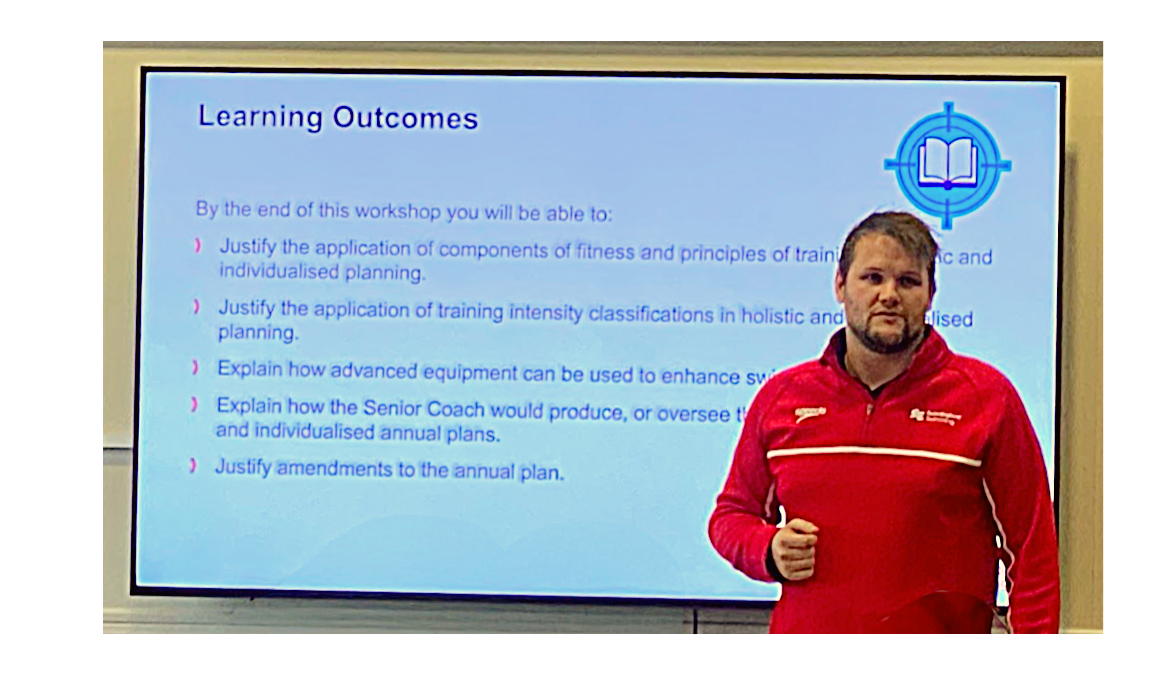
1: What we will learn
Ask questions. Ask why? What is the purpose? Look at different training models. Test it. Does it work? Reflect.
2: Don’t Fear Fast kids
We did a ‘true or false’ challenge with some urban myths. The only true ones were the sports benefits of nicotine (calming, but not recommended) and that sharks came before trees.
We related this to swimmer specific ‘myths’ and learnt that they are context specific.
Volume: progress it properly in pre-pubescent swimmers. They produce lactate but only in small amounts.
One style does not fit all.
Strong aerobic ability underpins all events as this gives them the ability to recover.
And gives them a strong immune system.
He is against too much intensive training for this age group.
Swimming Myths Applied to Graph
Adam Grant quotes
Learnings vs unlearning
Set elements
Set distance – volume
Set intensity
Rest
Repeat Distance
See example sets
Different ages, strokes and requirements.
Stroke rate vs stroke length
Importance of passive rest for ATP so three minutes rest
ATP for 10 seconds
One: Anaerobic Set 18 year old 10 FS 54.16 LC, 53.53 SC
Two: Anaerobic (Lactate) 16 year old 20 Fly 2:11.14 LC, 2:08.12 SC.
Use HRT monitor? Speed is more important than HRT.
Value of long rest
Three: Aerobic Set 14 year old 400m IM 5:00.87 LC, 4.58.39 SC.
Value of keeping it simple
NB: If after briefing you wipe the set off the board, will they remember it.
Get them to do a few things really well
Vs writing an ‘entertaining set’
Eg 8 x 1000m with 15” rest a favourite for a para Olympian.
All he had to think about was ‘keep my heart rate slow and plod along’
NB: Give them something they can remember.
Aerobic: low intensity and volume
Training Quality
Before, during and after
Plan > Execute > Debrief/Reflect
Control as many aspects as you can: technical, tactical, mental, physical, support, and luck.
Lesson learnt: coach all round
How are they spending their hours outside contact time?
Homeostasis: is about putting this under stress so that the body adapts.
Why periodise:
General adaptation
Super-compensation
Principles of Training
Specificity
Overload FITT
Adaptation: how you use recovery.
Recovery
Regression/Detraining
Mental Refreshment
Energy Systems
ATP: lasts 2 or 3 seconds prolonged by PCi for 10-12”
Meanwhile glycolysis cutting in.
ATP-PC system like a match – it will go out in 9-12”
Can be used to light a firework for 9-12” then shoots into the sky. You then have 90 seconds of glycolysis of fireworks.
It can tumble into a bonfire but so long as it is fuelled it will keep burning.
Lacate
Fatigue
Intensity Thresholds
Lactate Anaerobic
Maximal lactate
Lactate is broken down
If prepubescent lactate is produced but broken down.
What’s fuelling exercise?
Ceiling of their aerobic capacity
V02 Max
Heart and lungs (the limiting factor)
Blood and muscles
All under developed in kids.
At youth/senior level it is heart and lungs
Sprint beyond VO2 max
Female: 70% Aerobic 15% Anaerobic 5-10% VO2 max
Models
Energy system model
Critical Swim Speed
Ultra Short Race Pace Training
Polarised Training Model
80% A1/A2
20% AT/VO2
Polarised Training
Skill/Technique Model
Task: Learn a new model by January
Three Zones:
Moderate
Heavy
Severe
27: Training Classification Overview
28: All models work with the right athlete, in the right environment, at the right time of their journey.
Keep it simple, to quote Avril Lavigne
Exercise: what do I understand works between moderate, heavy and severe? That a swimmer would also understand?
Story of Ben Proud walking slowly between pool and accommodation.
Do they understand the intensity required of them? Could be the Teletubbies if they understand what you want.
VW Beetle – steady and reliable
Aston Martin – fast and agile
Bluebird rocket – the speed of sound
30. Planning
Identify the most important completion and work back.
31. Definitions
Micro-could be 10 days or 7. It’s up to you.
Meso-usually 4-6 weeks (the period of adaptation. Can be 2-8 weeks. It depends on the individual and the model used for the research.
Typically 22 First Olympians Experience
32: Age Group vs Seniors
33: Weekly Plan – Age Group: individual stroke nights, single stroke week is better for IM mix.
34. Pick one thing to fix until it happens, then add more.
Kid swimming too fast, add UWs and DPS.
35/36. Age Group
37. Manage Stress and Recovery
38. Build on Technique
Anaerobic 18 Year Old
Add resistance
Add passive rest
Level of understanding
Can you answer two why’s?
If they ask a third the’re being a pain!
Volume easy to track
Intensity is the most important
Testing and monitoring
Accurate and valid

